 Onyx
Onyx
Onyx liquid staking on Mainnet with native XCN and stXCN
Onyx liquid staking accepts native XCN on Onyx Mainnet and issues stXCN, the token representing your staked position. Ethereum XCN held in a wallet or staking contract needs the appropriate bridge or migration route before it becomes available there. The relevant wallet network is chain ID 327, and network switching alone does not move funds.
Your address can hold an Ethereum token balance and a separate Onyx balance. A legacy staking deposit adds another distinction: it sits inside a staking position until the withdrawal or migration flow makes XCN available.
The short version: A completed XCN bridge transfer may deliver native XCN without completing the optional staking action that produces stXCN.
Native XCN deposits and recorded rewards
Native XCN at the connected Onyx Mainnet address supplies the deposit for StakedXCNDirect, the contract accounting for liquid staking positions. The deposit produces stXCN representing the staked position. Rewards accrue using the contract’s current index and parameters. stXCN uses rebasing accounting, so accrued rewards can increase its reported balance without another staking deposit.
The app shows the stXCN balance, underlying XCN value, and earned rewards separately. The first field counts the position token; the second expresses the position in XCN. Estimated daily earnings and annual percentage rate (APR) describe projected accrual under the displayed parameters. Those projections do not establish that a separate reward payment has reached your wallet.
A successful staking receipt and the corresponding stXCN balance confirm the stake completed. Connecting a wallet or signing a preliminary authorization does not establish a completed stake.
Why does the staking app show no available XCN?
The staking app can show no available XCN when the connected address lacks native XCN on Onyx Mainnet, even with Ethereum holdings. Onyx Mainnet uses chain ID 327. An Ethereum XCN balance remains on Ethereum after a wallet network switch. A connected wallet’s total portfolio value also does not establish an available native balance on the selected chain. Address selection matters because each account has its own holdings.
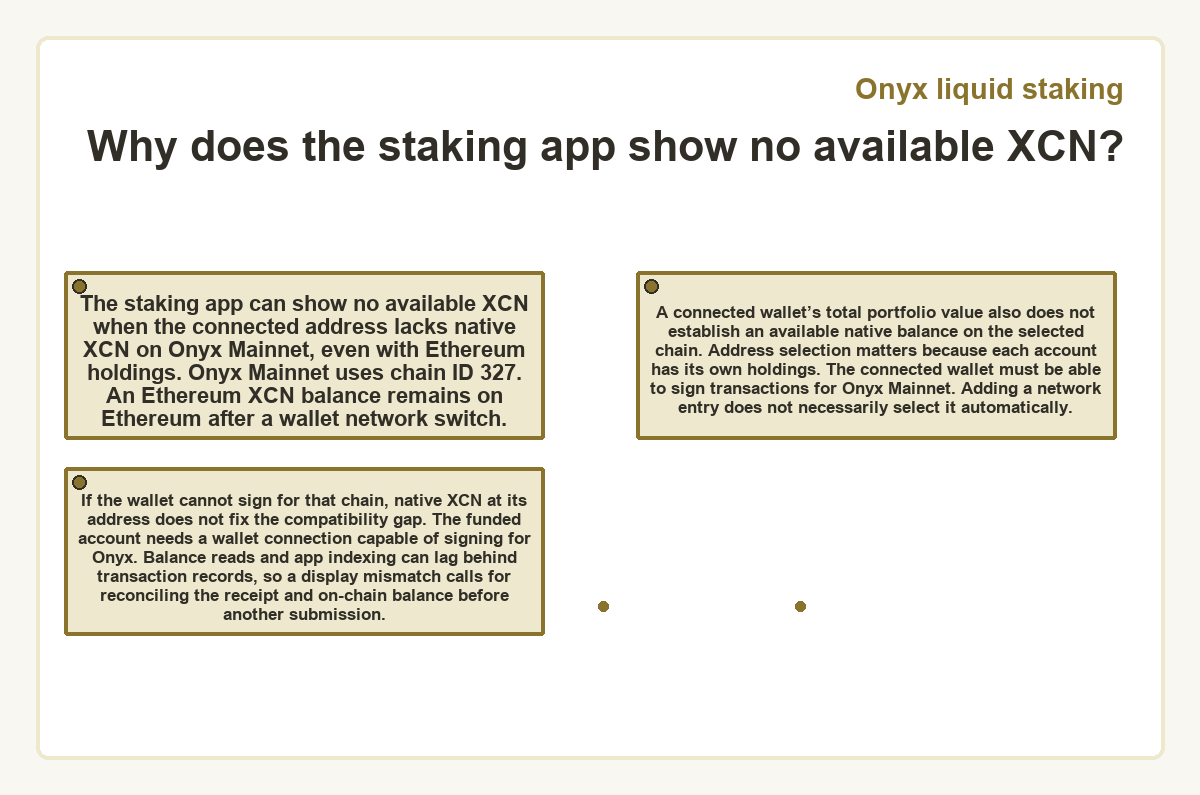
The connected wallet must be able to sign transactions for Onyx Mainnet. Adding a network entry does not necessarily select it automatically. If the wallet cannot sign for that chain, native XCN at its address does not fix the compatibility gap. The funded account needs a wallet connection capable of signing for Onyx. Balance reads and app indexing can lag behind transaction records, so a display mismatch calls for reconciling the receipt and on-chain balance before another submission.
Can an Ethereum staking position become stXCN on Onyx?
An eligible legacy Ethereum staking position can migrate to Onyx with optional auto-staking, after the flow withdraws XCN and bridges it. XCN already held in a wallet follows a different entry path. The starting balance determines which actions apply.
The bridge health checks report the service as operational. A maintenance notice in the interface alone does not establish that new transfers are paused. Bridge-dependent routes require an operational bridge and an amount meeting its live limits. The final quote determines the expected destination amount after bridge charges. Ethereum transactions need Ethereum gas, while subsequent Onyx transactions use native XCN.
| Starting position | Route into liquid staking | Balance and access required |
|---|---|---|
| Native XCN in an Onyx wallet | Stake through the Onyx App | Available native XCN and a wallet able to sign on Onyx Mainnet |
| ERC-20 XCN in an Ethereum wallet | Bridge XCN, then stake on Onyx | Wallet-held Ethereum XCN, ETH for gas, and an operational bridge |
| Legacy Ethereum-staked XCN | Migrate with optional auto-staking | An eligible withdrawable staking position, Ethereum gas, and an operational bridge |
The migration flow can request an XCN allowance, withdraw the legacy stake, bridge the available XCN, and apply optional auto-staking. Each wallet prompt authorizes its own action. A completed source transaction establishes the Ethereum leg; the destination staking action must succeed for stXCN delivery. Bridge delivery and liquid staking therefore have separate completion evidence.
If auto-staking cannot complete, the system can deliver native XCN and record the staking error. Manual staking can follow once its requirements are satisfied.
Staking costs and adjustable reward parameters
A self-funded staking deposit needs enough native XCN for the selected amount and the transaction’s network cost. The deposit funds the staked position; gas pays for execution. Gas usage and the gas price together determine the network’s XCN charge.
Migration or bridging can add Ethereum execution costs and application-level bridge charges. The bridge can apply percentage fees, minimum fees, or both, and those terms vary by direction. Its quoted receive amount describes bridge delivery. It does not by itself establish the stXCN quantity an optional staking action will produce. Keep the deposit input, destination XCN, and position balance distinct when comparing the amounts.
The contract owner can change staking reward rates and protocol fees, pause staking, or upgrade the contracts. The APR display is an estimate tied to those parameters. A previous Ethereum staking rate or a validator reward figure does not determine earnings for an stXCN holding.
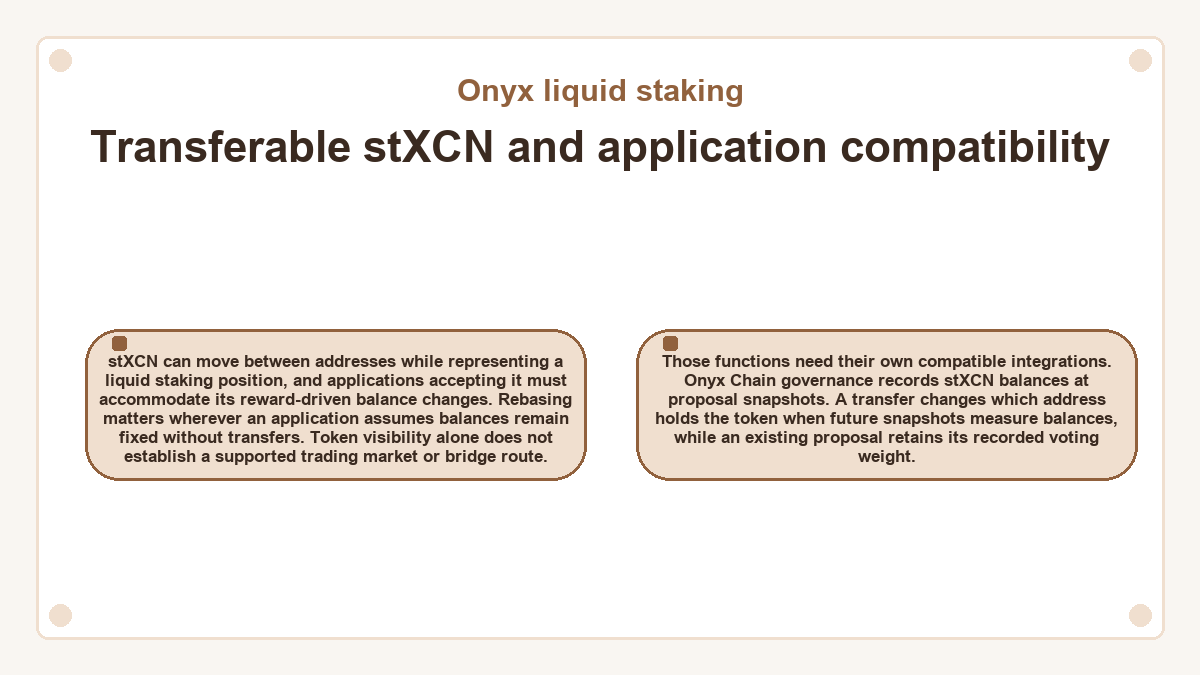
Transferable stXCN and application compatibility
stXCN can move between addresses while representing a liquid staking position, and applications accepting it must accommodate its reward-driven balance changes. Rebasing matters wherever an application assumes balances remain fixed without transfers. Token visibility alone does not establish a supported trading market or bridge route. Those functions need their own compatible integrations. Onyx Chain governance records stXCN balances at proposal snapshots. A transfer changes which address holds the token when future snapshots measure balances, while an existing proposal retains its recorded voting weight.
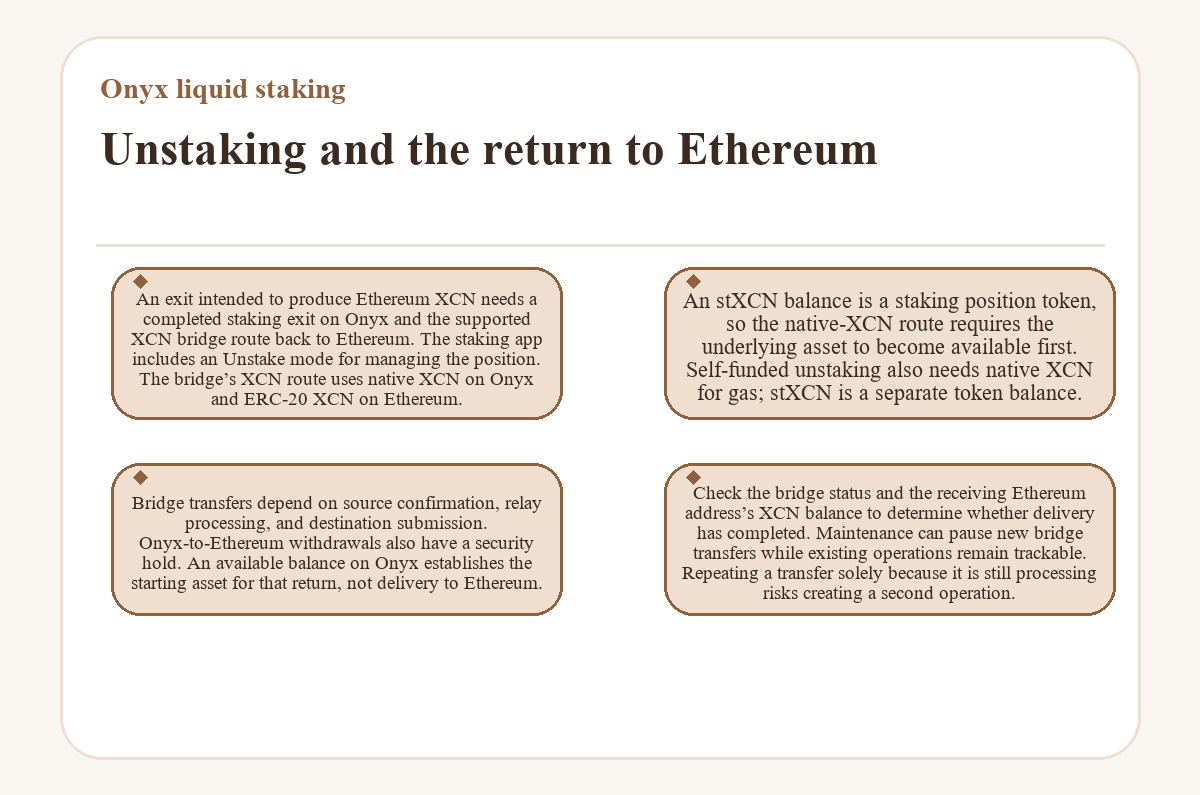
Unstaking and the return to Ethereum
An exit intended to produce Ethereum XCN needs a completed staking exit on Onyx and the supported XCN bridge route back to Ethereum. The staking app includes an Unstake mode for managing the position. The bridge’s XCN route uses native XCN on Onyx and ERC-20 XCN on Ethereum. An stXCN balance is a staking position token, so the native-XCN route requires the underlying asset to become available first. Self-funded unstaking also needs native XCN for gas; stXCN is a separate token balance.
Bridge transfers depend on source confirmation, relay processing, and destination submission. Onyx-to-Ethereum withdrawals also have a security hold. An available balance on Onyx establishes the starting asset for that return, not delivery to Ethereum. Check the bridge status and the receiving Ethereum address’s XCN balance to determine whether delivery has completed. Maintenance can pause new bridge transfers while existing operations remain trackable. Repeating a transfer solely because it is still processing risks creating a second operation.
Reader questions
-
Does adding stXCN to my wallet start liquid staking?
- Selecting Add stXCN makes the Onyx Mainnet token visible in your wallet; it does not create a staking position. A balance must already exist or result from a supported staking or token transfer action. Adding the token entry alone does not spend native XCN or establish reward accrual.
-
Do I need to run a validator to earn stXCN rewards?
- You do not need to operate a validator to hold a liquid staking position. Liquid staking through the app accepts native XCN and returns stXCN to the wallet. Validator rewards apply to eligible node operators through a different mechanism. Selecting a validator-dashboard rate as the expected stXCN return would combine two different reward systems.
-
Are Onyx Points included in my stXCN staking earnings?
- Onyx Points follow separate program rules from the staking contract’s reward accounting. Point eligibility can depend on the active season, chain, asset, and qualifying action. Enrolling in a points program does not establish that native XCN entered liquid staking. An absent points balance also does not, by itself, prove an stXCN reward failure.
-
Does a WXCN balance count as native XCN for liquid staking?
- Wrapped XCN is a separate ERC-20 representation, while the liquid staking deposit uses native XCN. A WXCN holding therefore does not establish the native balance required by that deposit method. Its appearance in a wallet or liquidity pool is a different state from spendable native XCN.
-
Is Testnet XCN eligible for Onyx Mainnet liquid staking?
- Testnet XCN cannot fund an Onyx Mainnet liquid staking position. Mainnet uses chain ID 327, while Onyx Testnet uses chain ID 8901. Their balances belong to different environments, and Testnet assets have no Mainnet value. Matching address formats or token labels do not make a Testnet balance eligible for the Mainnet deposit.
-
What does an Ethereum XCN approval authorize during migration?
- An Ethereum XCN approval gives the selected spender permission to move tokens up to an allowance. It establishes authorization, not a completed withdrawal, bridge delivery, or stXCN position. The migration flow requests an allowance when required, alongside its other actions. Read the spender and amount in that prompt because an allowance controls spending permission even before the destination balance changes.
Updated ·